Projects
Catcha: Distributed Card Platform
AcademicA scalable, containerized trading card ecosystem built with JavaScript, Astro, React, and a Node.js Microservices architecture.
Links
Timeline
Team
4 contributors
Tech Stack
JavaScript Astro React Node.js Express MongoDB Microservices
This project, titled “Catcha,” is a distributed web application for collecting digital cards. Developed by a team of 4, the goal was to move away from monolithic structures and design a scalable Microservices Architecture orchestrated via Podman.
Architecture & Infrastructure
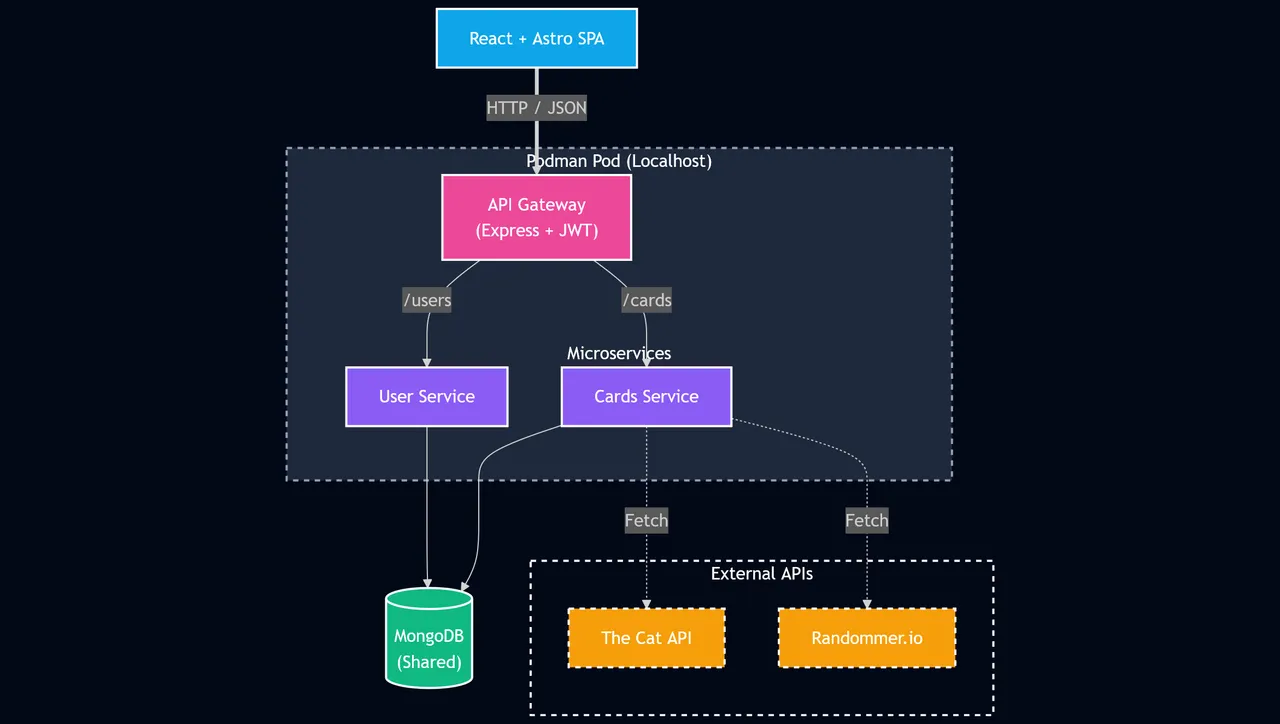
The application is composed of four distinct services communicating via REST APIs:
- Frontend: A responsive Single Page Application (SPA) built with Astro and React. We chose JavaScript for the entire stack to ensure consistency between frontend and backend.
- API Gateway: A centralized Express service that routes requests and secures the platform using JWT Authentication.
- User Service: An Express microservice handling user accounts, inventory management, and the logic for the 12-hour free booster timer.
- Cards Service: An Express microservice responsible for procedural content generation. It aggregates data from external APIs (The Cat API, Randommer.io) to create unique cards.
Backend Logic & Quality
- Runtime: All backend services run on Node.js using the Express framework.
- Persistence: Data is stored in MongoDB, using Mongoose for strict schema validation.
- Economy Logic: The system includes automated logic to detect duplicate cards upon booster opening, automatically selling them and updating the user’s currency balance atomically.
- Testing: We prioritized code quality by implementing comprehensive Unit Tests for Controllers, Models, and DAOs to ensure system reliability.
DevOps & Deployment
The infrastructure is fully containerized. We used Podman to create a unified pod, mapping internal ports (3939-3941) and orchestrating the startup of the Gateway, Database, and Microservices simultaneously.