Networked Connect 4
AcademicImplementation of multiplayer netcode in Go: Client-Server architecture, custom binary TCP protocol, and concurrency management via Goroutines.
Links
Timeline
Team
Tech Stack
Project Context
Developed as part of the System Programming (R3.05) module, this project aimed to transform a local Connect 4 game (built with Ebitengine) into a fully functional online multiplayer game.
The main challenge was not the game logic, but designing the “net code” allows two remote clients to synchronize their states via a central server.
Technical Architecture
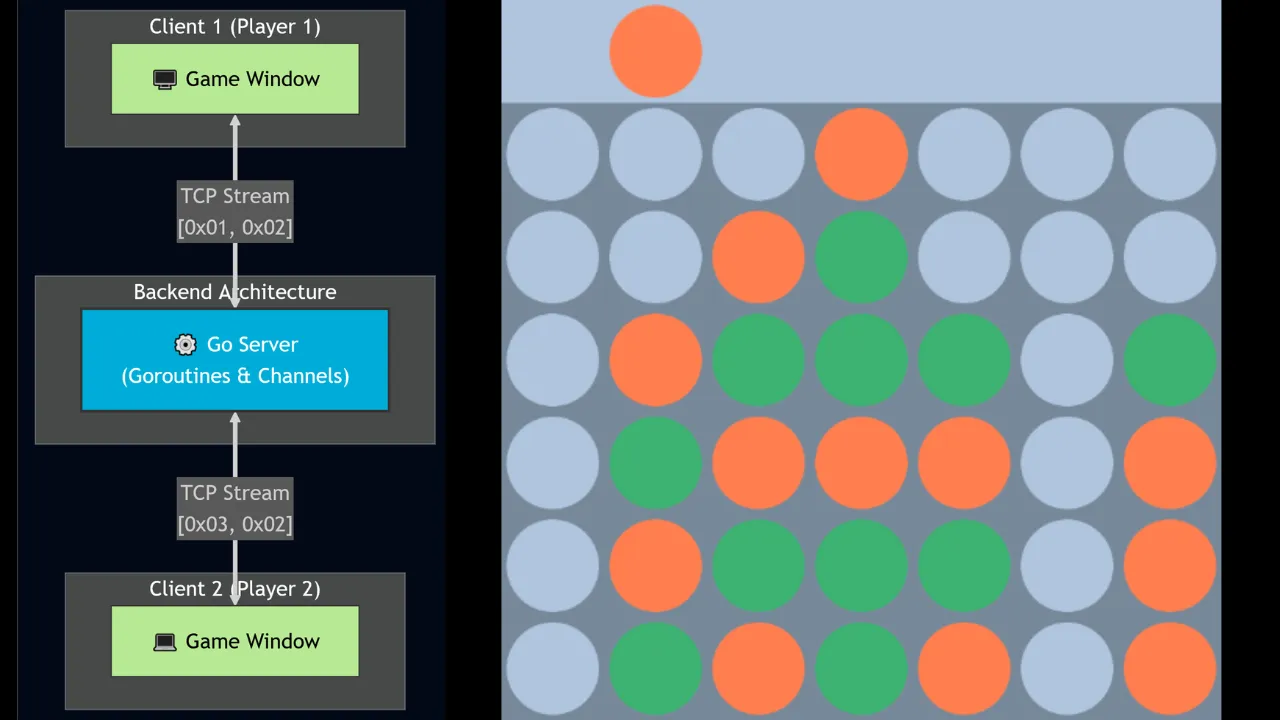
The application relies on a strict Client-Server architecture where the server acts as the authority on the game flow.
1. Concurrency Management (Go)
The core of the project leverages Go’s powerful concurrency primitives:
- Goroutines: Each connected client is handled by an independent lightweight goroutine on the server side (in
handlers.go), ensuring the main loop remains non-blocking. - Channels: Heavily used for thread-safe communication between network reading processes and the game update logic (
update.go).
2. Communication Protocol
We designed a custom binary protocol over TCP to minimize latency. Messages are structured as [Data Byte, Type Byte]:
0x01: Sending selected color (OctetPlayerColor).0x02: Sending player move (column index) (OctetOpponentMove).0x03: State synchronization (Ready / Waiting) (OctetOpponentState).
3. State Synchronization
The server orchestrates the different game phases to ensure both players see the same state:
- Lobby: Waiting for the second player to connect.
- Selection: Synchronizing color choices (preventing duplicate colors).
- Gameplay: Relaying moves in real-time.
- Endgame: Handling game restart (Re-match) logic.
Improvements & Extensions
Beyond the initial requirements, we enriched the application to enhance the multiplayer experience:
Architecture & Network
- Concurrent Handling: The server manages each client in a dedicated goroutine, effectively separating game logic from network communication management.
- Easy Configuration: Implemented a startup screen for Server IP input (replacing the previous command-line flag method).
Advanced Synchronization (Selection Phase)
We made the color selection screen interactive in real-time:
- Visualization: The opponent’s cursor movements are visible live while they are making their selection.
- Game Constraints: Locking system preventing both players from picking the same color.
- Flexibility: Ability to change color selection as long as the opponent hasn’t confirmed theirs.