Room Management Microservices
AcademicA distributed architecture composed of three Kotlin Spring Boot services implementing a BFF pattern for managing users and room reservations.
Links
Timeline
Team
Tech Stack
Project Overview
This academic project focused on building a modular Room Management System using a Microservices Architecture. The goal was to separate concerns into distinct services while orchestrating them through a Backend For Frontend (BFF) layer.
The project was developed in a pair with Samuel Amaral Antunes.
Architecture
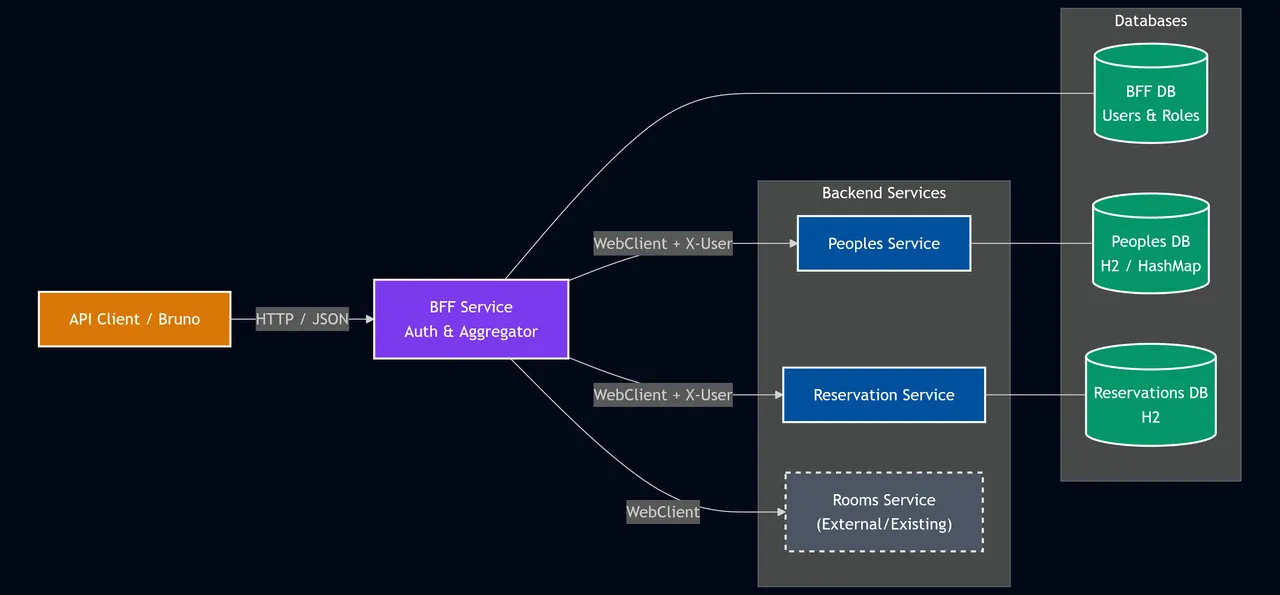
The system is divided into three distinct Spring Boot applications, plus a provided “Rooms” service:
- Peoples Service: Handles user identity and profile management.
- Reservation Service: Manages room booking logic and validation.
- BFF (Back For Front): Acts as a proxy and aggregator, handling security and exposing unified endpoints to the client.
1. Peoples Service
A specialized registry for users.
- Constraint Challenge: We were restricted from using standard Spring annotations (
@Service,@Repository) to enforce understanding of manual bean wiring and layered architecture in Kotlin. - Dual Data Source: Implements a switchable storage engine (H2 for production,
HashMapfor DEV profiles).
2. Reservation Service
The core logic engine.
- Tech Stack: Uses
WebClientexclusively for communication between services. - Logic: Handles complex temporal validation (overlapping dates, start/end time logic) and interacts with the Peoples and Rooms services to validate IDs.
3. BFF & Aggregation
The entry point for the frontend.
- Security: Implements Spring Security to manage
ADMINaccess for creating resources. - Aggregation: Synthesizes data from multiple microservices into single response objects (Data Classes). For example, fetching a User automatically aggregates their detailed reservation history.
- Header Injection: Enforces strict header passing (
X-User) to downstream services.
Testing Strategy
To ensure the robustness of the distributed architecture, comprehensive test coverage was implemented across each of the three services:
- Unit Tests (JUnit): Isolated validation of business logic and management rules (e.g., schedule overlaps).
- Integration Tests (
@SpringBootTest): Verification of Spring context loading and dependency injection chains. - API Validation: Use of Bruno collections to certify compliance with the expected interface contracts (inputs/outputs).